If you’ve been researching SUNDEK pool deck coatings, you’ve probably come across two names more than any others: Classic Texture and SunSplash. Both are proven acrylic spray systems. Both are slip-resistant, UV-stable, and built for outdoor concrete surfaces. Both have been installed on pool decks throughout the Gulf Coast for decades.
So what’s the difference — and how do you choose between them?
The answer depends on three things: the look you want, the feel you want underfoot, and your budget. This guide walks through both systems side by side so you can make an informed decision before your estimate.
As the only authorized SUNDEK installer in Louisiana, South Mississippi, and South Alabama, we’ve installed both systems on hundreds of Gulf Coast pool decks. Here’s what we’ve learned.
Quick Answer: How Classic Texture and SunSplash Differ
Both systems start the same way: a polymer acrylic coating is spray-applied over prepared concrete in textured globules. What happens next is where they diverge.
Classic Texture: After spraying, the texture globules are knocked down with a trowel while still wet. This flattens the peaks and creates a smooth-topped, low-profile texture — consistent, refined, and comfortable underfoot. It’s the original SUNDEK system, introduced in 1970, and it remains the most widely specified pool deck coating in the country.
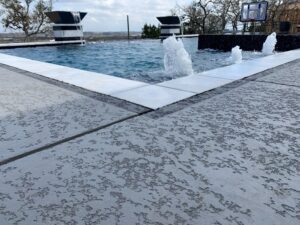
SunSplash: The globules are not troweled. They’re left as-sprayed, creating a more pronounced, raised texture with a rougher, more rustic surface profile. This gives SunSplash more aggressive slip resistance and a distinctly different visual character — less uniform, more natural-looking.
That single step — troweled vs. untroweled — creates two meaningfully different finished surfaces.
Classic Texture — The Gulf Coast Standard
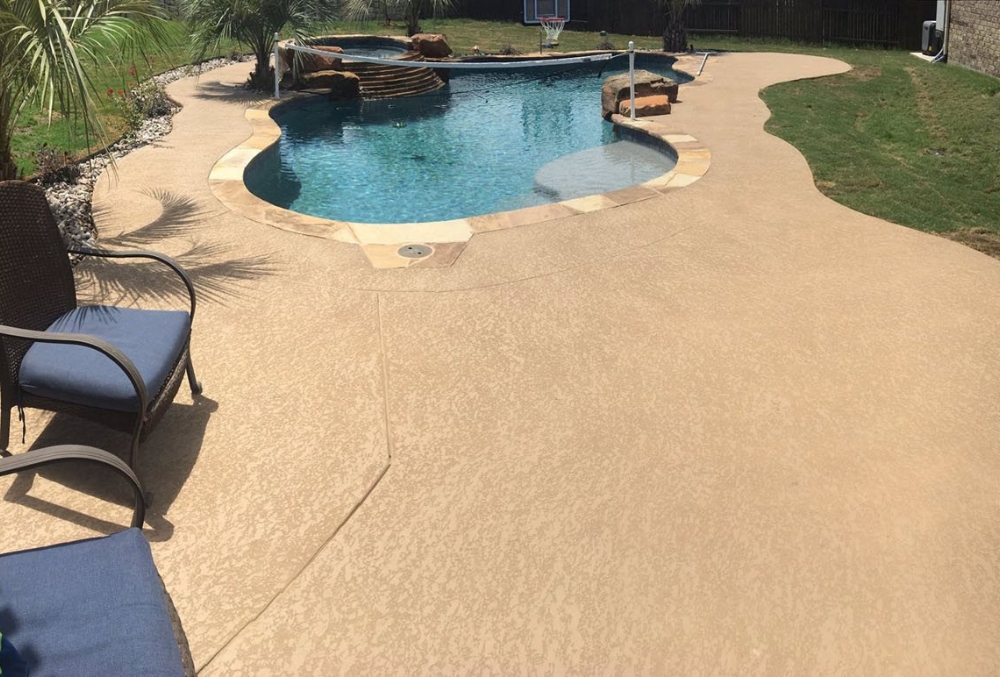
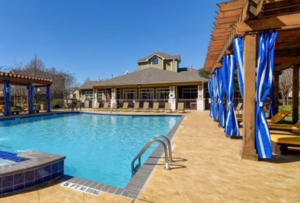
Classic Texture is the system that helped launch the decorative concrete industry in 1970, and it’s been refined continuously since. On the Gulf Coast, it’s the default specification for residential pool decks, commercial aquatic facilities, hotel pool areas, and HOA common spaces — for good reason.
What it looks like: A smooth-topped, consistent knockdown texture. The surface has visual interest and dimension without being rough or irregular. Color is applied in a base coat and finish coat system, giving depth and richness that flat-painted concrete can’t match. Available in a wide range of colors, and combinable with score cut lines, masonry effects, and border treatments for custom designs.
What it feels like: Comfortable on bare feet — even after a full day in the South Louisiana sun. The troweled-down texture stays significantly cooler than bare concrete by reflecting heat rather than absorbing it, while still providing reliable traction in wet conditions. This is the system thousands of Gulf Coast homeowners have walked across their entire lives without realizing it had a name.
Performance in Gulf Coast conditions: Classic Texture was designed for exactly the environment we work in. It’s non-porous, so environmental pollutants, pool chemicals, and organic matter sit on the surface rather than penetrating it. It’s UV-stable, so the color holds without significant fading under sustained South Louisiana sun. It breathes, which matters for concrete substrates in high-humidity environments where moisture vapor transmission is a constant consideration.
Best applications:
- Residential pool decks — the primary and most popular use
- Patios and outdoor living spaces adjacent to pools
- Commercial pool decks, hotel pools, resort facilities
- HOA and multi-family amenity areas
- Walkways, driveways, and front entries where a refined finish is preferred
Customization options: Classic Texture is the most combinable system in the SUNDEK lineup. It can be paired with:
- SunStamp — stamped borders or full-deck patterns for a custom stone or tile look
- Tuscan — hand-crafted troweled overlay for European aesthetic
- SunStone — architectural limestone-look coating
- Custom score cut lines for geometric or natural stone patterns
- Two-tone or multicolor applications
Cost position: Mid-range. Higher material and labor cost than SunSplash due to the additional troweling step, but the most cost-effective system for the finished quality delivered.
SunSplash — The Economical Acrylic Spray Texture
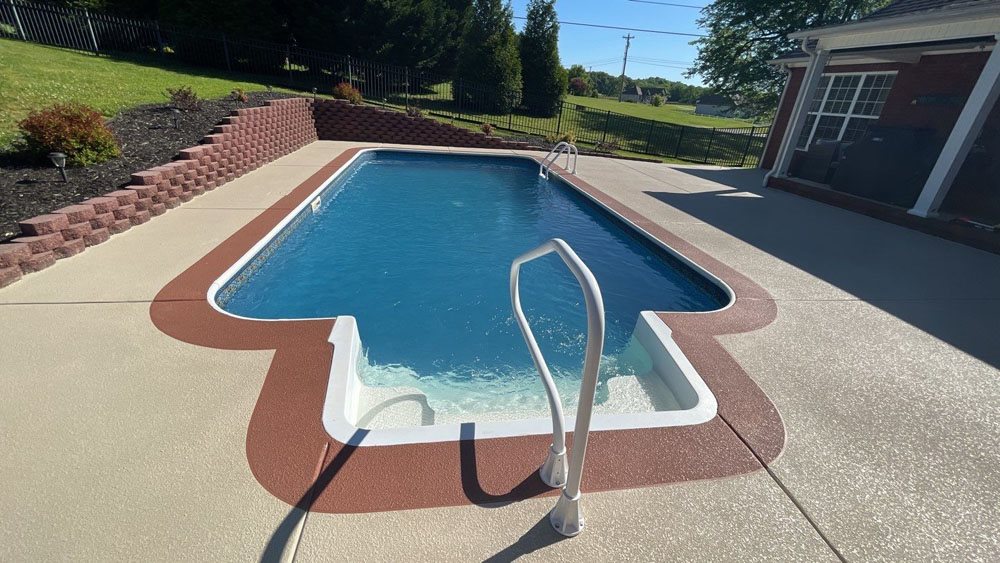
SunSplash is Classic Texture’s more accessible sibling. Same acrylic polymer chemistry, same spray application process, same color system — but without the knockdown troweling step. The result is a more textured, more rustic surface at a lower installed cost.
What it looks like: An untroweled, raised spray texture with a more pronounced, irregular surface profile. The peaks of the sprayed globules remain intact, giving the surface a rougher, more organic appearance. It reads as more casual and less refined than Classic Texture — which suits certain project types and aesthetics well.
What it feels like: More texture underfoot than Classic Texture — coarser, with more surface relief. The aggressive texture provides excellent slip resistance, which makes SunSplash a strong choice for areas with heavy water exposure, splash zones, and surfaces where maximum traction is the priority. The tradeoff is that it’s less comfortable for extended barefoot walking than Classic Texture’s smoother knockdown finish.
Performance in Gulf Coast conditions: SunSplash carries the same fundamental performance characteristics as Classic Texture — UV-stable, water-resistant, non-porous, formulated for outdoor concrete. The untroweled surface profile does collect more debris in the texture peaks than Classic Texture, which means slightly more effort in cleaning. A pressure wash handles this easily, but it’s worth knowing going in.
Best applications:
- Budget-conscious pool deck projects where cost is the primary driver
- Splash pad areas, water play areas, or heavy-use aquatic zones where maximum slip resistance matters more than comfort
- Vertical surfaces — SunSplash applies cleanly to vertical concrete, making it useful for pool bond beams, retaining walls, and raised planters
- Secondary deck areas or utility surfaces where Classic Texture’s finish quality isn’t required
- Commercial projects with large square footage where cost per square foot is a significant factor
Customization options: SunSplash supports color variation and basic design work, though its untroweled texture profile limits the refinement of custom patterns compared to Classic Texture.
Cost position: Lower than Classic Texture. The elimination of the knockdown troweling step reduces labor time, which translates directly to a lower installed cost per square foot.
Side-by-Side Comparison
| Classic Texture | SunSplash | |
| Application method | Spray-applied, troweled down | Spray-applied, untroweled |
| Surface profile | Smooth-topped knockdown texture | Raised, pronounced spray texture |
| Comfort underfoot | High — smooth and cool | Moderate — coarser texture |
| Slip resistance | Excellent | Excellent — more aggressive |
| Visual character | Refined, consistent, professional | Rustic, organic, casual |
| UV stability | Excellent | Excellent |
| Gulf Coast humidity performance | Excellent | Excellent |
| Cleaning | Easy — low-profile texture | Easy — slightly more texture to clean |
| Customization range | Widest — combinable with stamps, stone effects, score lines | Basic — color variation and simple designs |
| Vertical surface application | Possible | Well-suited |
| Best for | Pool decks, patios, HOA, hotel pools, refined residential | Budget pool deck, splash zones, vertical surfaces, large commercial |
| Relative cost | Mid-range | Lower |
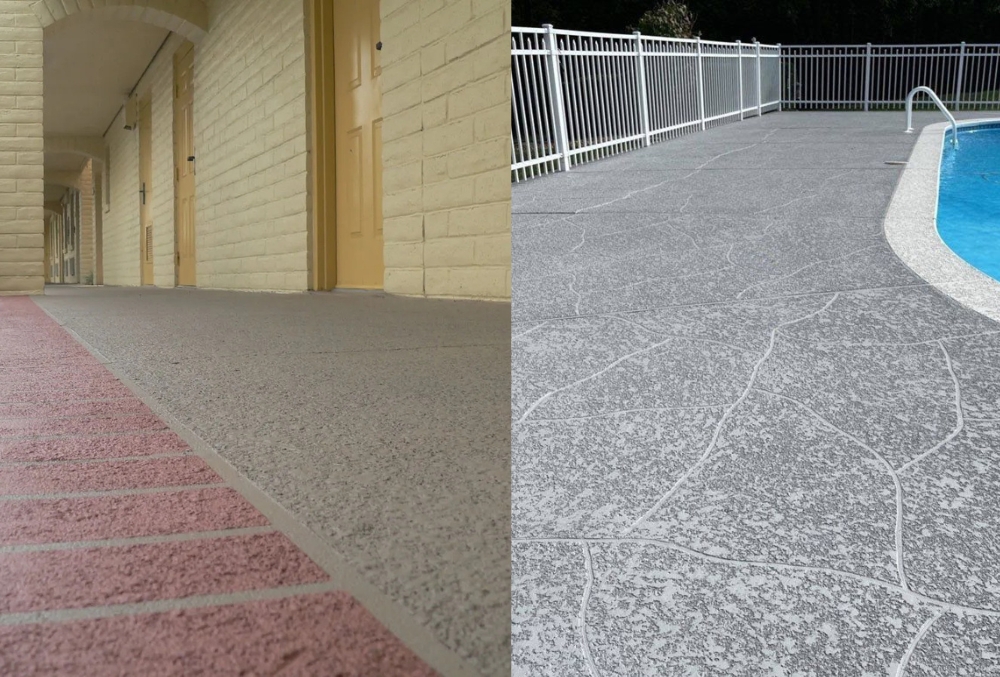
Which One Should You Choose?
Choose Classic Texture if:
- This is your primary residential pool deck and you’ll be walking it barefoot every day
- Appearance matters — you want a refined, professional finish that holds up aesthetically for years
- You’re interested in custom design elements like score lines, borders, or combined system effects
- The project is commercial, HOA, or hospitality — environments where the finish quality reflects on the property
- You want the system with the longest track record and widest installer expertise on the Gulf Coast
Choose SunSplash if:
- Budget is the primary consideration and you need a quality, durable surface at the lowest viable cost
- Maximum slip resistance matters more than comfort — splash pads, water play areas, or high-traffic aquatic zones
- You’re coating vertical surfaces alongside the horizontal deck (bond beams, planters, steps)
- It’s a secondary or utility surface where Classic Texture’s finish quality isn’t required
When you’re genuinely unsure: most homeowners who walk the deck regularly in bare feet choose Classic Texture once they feel the difference in surface comfort. The price difference between the two systems on a standard residential pool deck is often smaller than expected — worth discussing with us before making a final call.
A Note on Installation Quality
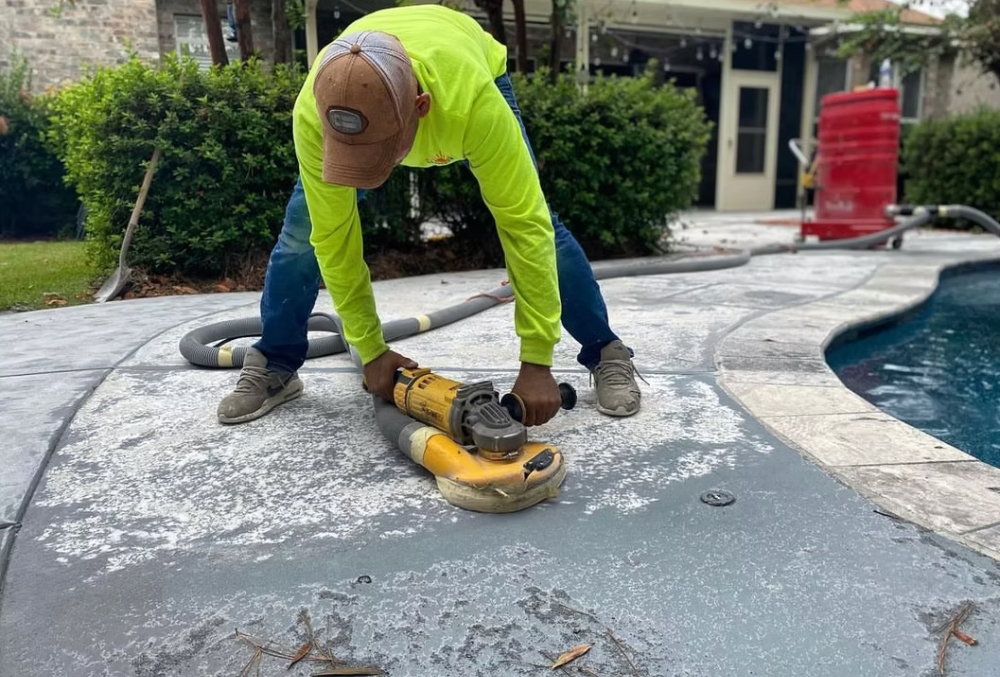
Both systems are only as good as the installation behind them. The single most important variable in the performance of any SUNDEK coating — Classic Texture or SunSplash — is surface preparation.
Cleaning, crack repair, and mechanical profiling of the substrate create the bond that determines how long the coating lasts. An under-prepared surface under a quality coating fails faster than a properly prepared surface under an economical one. This is why the contractor matters as much as the product.
Concrete Coatings Inc. is the only authorized SUNDEK installer on the Gulf Coast. That authorization means factory-trained installation crews, genuine SUNDEK materials, and accountability to the manufacturer’s standards on every project. We’ve been doing this work in Louisiana since the late 1980s — and we’ve seen what Gulf Coast conditions do to shortcuts.
Ready to Choose? We’ll Help You Decide On-Site
The best way to choose between Classic Texture and SunSplash isn’t a blog post — it’s seeing samples on your actual concrete, in your actual light, next to your pool. We bring samples to every estimate.
Concrete Coatings Inc. provides free, no-obligation estimates for pool deck coating projects throughout New Orleans, the North Shore, South Shore, Baton Rouge corridor, South Mississippi, and South Alabama.
Call 985-542-2757 or contact us online to schedule yours.
Frequently Asked Questions
What is the main difference between Classic Texture and SunSplash? Both are SUNDEK acrylic spray texture systems applied over existing concrete. The key difference is finish: Classic Texture is troweled down after spraying, creating a smooth-topped knockdown texture that’s comfortable for bare feet. SunSplash is left untroweled, creating a more pronounced, rougher texture with more aggressive slip resistance. SunSplash is also the more economical option.
Is Classic Texture or SunSplash better for a pool deck? Classic Texture is the more widely specified option for residential pool decks — it’s more comfortable underfoot and offers more design flexibility. SunSplash is a strong choice for homeowners prioritizing budget or for high-splash areas where maximum traction matters more than surface comfort. Both systems hold up well in Gulf Coast conditions.
How long do Classic Texture and SunSplash last on the Gulf Coast? Both systems, when properly installed over a well-prepared surface, typically last 8–15 years in South Louisiana conditions. Longevity depends on preparation quality, UV exposure, and how the surface is maintained. Both can be recoated — refreshing the color and sealant coat — before a full resurfacing is needed.
Can SunSplash be applied to vertical surfaces? Yes. SunSplash is well-suited for vertical concrete applications including pool bond beams, retaining walls, raised planters, and steps. Its untroweled texture applies cleanly to vertical surfaces in ways that Classic Texture’s troweling step doesn’t accommodate as well.Does Concrete Coatings Inc. install both Classic Texture and SunSplash? Yes. As the only authorized SUNDEK installer in Louisiana, South Mississippi, and South Alabama, we install the full SUNDEK product line — including Classic Texture, SunSplash, SunStamp, SunOne, and other systems. We bring samples to every estimate and can recommend the right system for your specific project, surface condition, and budget.