Pool season on the Gulf Coast doesn’t ease in gently. By the time June arrives, you’re already dealing with daily heat, intense UV, afternoon thunderstorms, and a pool deck that’s getting walked on barefoot every single day.
If your deck has been showing signs of wear and you’ve been putting off the decision — this is the post for you. Not every problem requires a full resurfacing. But some things that look like cleaning or maintenance issues are actually surface failures, and knowing the difference determines whether you spend the next two months dealing with the same recurring problems or solving them properly.
Here are the five signs that tell us, after 37 years of Gulf Coast pool deck installations, that a deck is past maintenance and ready for resurfacing.
Sign #1: The Surface Is Rough Enough to Scratch Skin
This is the most common complaint we hear: “The deck used to feel smooth and now it’s tearing up my kids’ feet.”
That transition from smooth to abrasive doesn’t happen because the surface got dirty. It happens because the coating itself has worn through to the substrate beneath — or because the coating material has physically degraded and its surface layer has eroded away.
On the Gulf Coast, this process accelerates faster than in most markets. The combination of UV exposure, high humidity, and thermal cycling — hot summer days followed by relatively cooler nights — breaks down acrylic coating systems from the outside in. Once the surface becomes rough, the abrasion is structural. You’re not going to scrub or seal your way back to smooth.
What it means: The coating has reached the end of its service life. The rough texture is bare or degraded substrate, not surface contamination.
What it looks like in practice: Feet and legs getting scratched or scraped during normal pool use. A noticeably different texture in high-traffic areas compared to shaded or lower-traffic sections of the deck. Towels catching on the surface.
What won’t fix it: Pressure washing, resealing, or applying a topcoat over a heavily degraded surface. A new coating needs a sound substrate to bond to — resurfacing over severely worn material doesn’t last.
The solution: A professional resurfacing — proper surface preparation, crack treatment, and a fresh SUNDEK system applied to a sound base. SUNDEK Classic Texture restores a smooth, comfortable, slip-resistant surface that handles daily barefoot traffic the way your original deck did.
Sign #2: Stains That Don’t Respond to Cleaning
There’s a clear line between a stained pool deck and a pool deck with penetrating stains. Surface staining — organic debris, algae residue, general discoloration from use — responds to proper cleaning with appropriate products. Penetrating stains have worked into the porous surface material itself, and no cleaning regimen removes them.
South Louisiana makes this worse. High humidity and warm temperatures year-round mean organic matter (leaves, pollen, algae spores) is constantly present. A pool deck that’s developed any surface porosity — from aging, UV degradation, or a worn sealant layer — becomes a sponge for this material. Iron and mineral staining from hard water and irrigation runoff compounds the problem.
The test: If you’ve pressure washed, applied deck cleaner, and the stains are still there — they’re in the surface, not on it.
What it means: The coating’s non-porous barrier has failed. Once organic and mineral compounds have penetrated the surface layer, they cannot be extracted by cleaning alone.
What it looks like in practice: Persistent dark or rust-colored patches that remain after a thorough clean. Staining concentrated in grout lines, texture peaks, or areas with regular water runoff. Discoloration that’s been present for more than one season.
The solution: Resurfacing removes the stained surface layer and replaces it with a fresh, non-porous coating. SUNDEK Classic Texture and SunSplash are both non-porous systems — environmental contaminants sit on the surface rather than absorbing into it, making cleaning straightforward for the life of the coating.
Sign #3: Cracking — Especially the Spider Web Kind
Some cracks on a pool deck are cosmetic. Others are telling you something structural is happening beneath the surface. The distinction matters for what you do next.
Hairline cracks — fine, single-line cracks in the coating layer — are often a cosmetic issue, particularly in older acrylic systems that have lost flexibility. They can sometimes be addressed with crack treatment and recoating if the underlying concrete is sound.
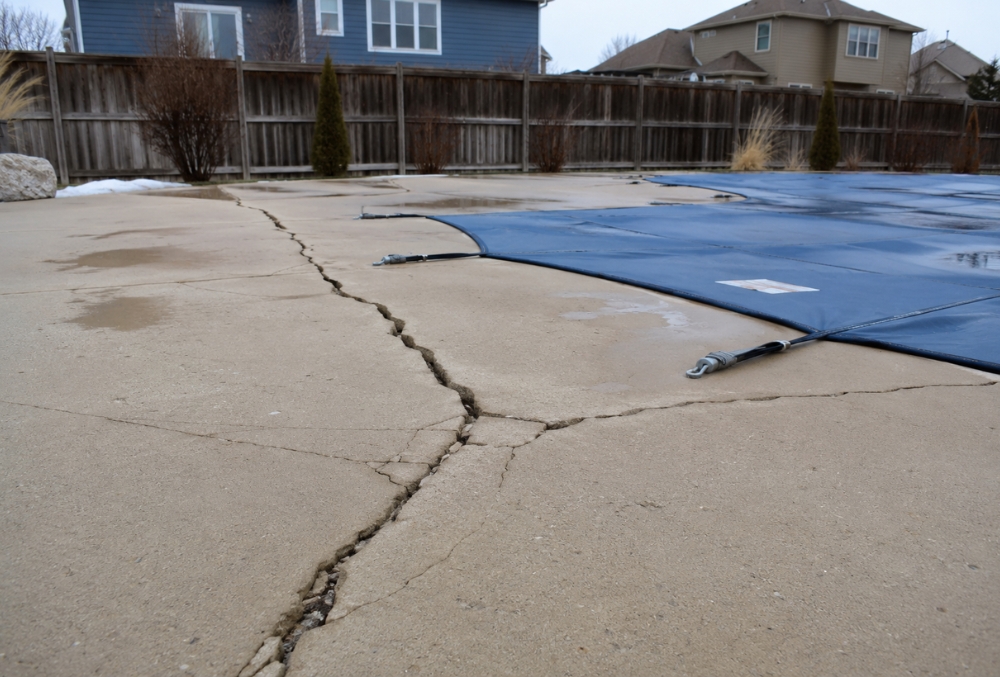
Spider cracks (crazing) — the web-like network of interconnected fine cracks spreading across a section of deck — are a more serious signal. They typically indicate that the coating system has become brittle and lost its ability to flex with the natural expansion and contraction of the concrete below.
On the Gulf Coast, this failure mode is particularly common. Summer temperatures in South Louisiana regularly push above 95°F, and the concrete substrate expands and contracts significantly between the heat of the day and the relative cool of morning. Coating systems that have aged past their flexible phase crack under this thermal movement rather than accommodating it.
What it looks like in practice: A network of fine cracks radiating from a central point or spreading across an area of deck. Cracks that weren’t present two or three seasons ago and are now visible across multiple sections. Edges of cracks that are beginning to lift or show displacement.
Why it matters now: Spider cracks are an early warning. Left unaddressed, they allow water infiltration into the substrate — which, in Louisiana’s high-rainfall environment, accelerates deterioration significantly. The longer this goes, the more extensive (and expensive) the prep work becomes before resurfacing.The solution: Proper crack treatment during surface preparation, followed by a fresh flexible coating system. SUNDEK products are formulated to accommodate the thermal movement that causes this failure mode — addressing the mechanical cause, not just the visible symptom.
Sign #4: Color That Has Faded, Bleached, or Gone Uneven
A pool deck that was installed with a rich, consistent color — whether tan, gray, terracotta, or slate — and now looks washed out, blotchy, or noticeably different on the sun-exposed side versus the shaded side has a UV degradation problem, not a cleaning problem.
South Louisiana receives intense UV year-round. Pool decks in this region see more cumulative sun exposure in a single year than decks in most other markets in the country. Acrylic coating pigments that aren’t properly sealed and maintained fade under this sustained UV contact, particularly on decks with western or southern exposure.
Uneven fading is one of the more telling patterns — the section that gets full sun all afternoon has bleached out significantly, while the section under a pergola or overhang still shows close to the original color. This confirms it’s UV degradation, not general wear.
What it means: The UV-protective sealant layer has worn through and the underlying color coat is being degraded by direct sun exposure. Reseal timing has passed.
What it looks like in practice: Deck color that looks dull or washed out compared to early-season photos. Two-tone appearance between shaded and unshaded sections. Color that hasn’t responded to cleaning the way it used to.
What won’t fix it: Cleaning won’t restore faded color. A fresh sealant coat can slow further fading if caught early, but once the color coat itself has degraded significantly, the only restoration is resurfacing.The solution: A fresh SUNDEK system restores consistent, rich color and applies a UV-stable finish coat that protects the new color for the coating’s full service life. For homeowners who’ve dealt with fading before, it’s also worth asking about color selection — some colors and finishes hold up better under South Louisiana UV conditions than others. We can advise on that during your estimate.
Sign #5: Algae That Returns Within Days of Treatment
Algae is a water chemistry issue — until it isn’t.
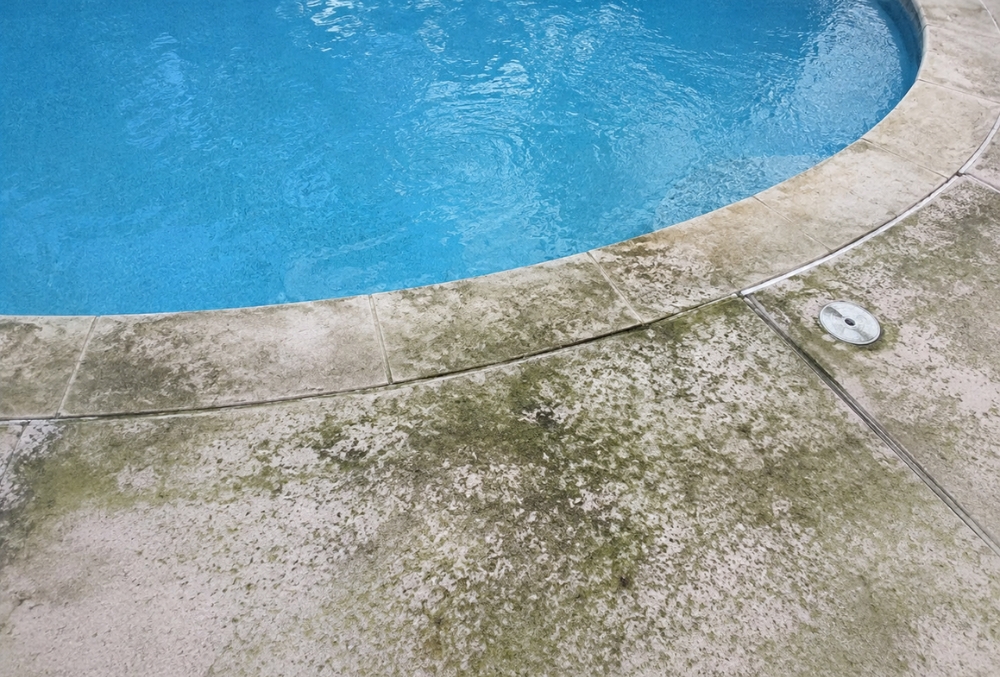
If you’re shocking the pool, balancing chemistry correctly, and your deck is still showing algae regrowth within a few days of treatment, the deck surface itself is the problem. Algae needs physical anchors to establish colonies that resist sanitizer contact. A smooth, non-porous coating gives algae nothing to grip. A rough, porous, or degraded surface gives it countless anchor points — in texture peaks, surface pores, and micro-cracks — where colonies can establish and repopulate faster than surface treatment can eliminate them.
This is a surface failure masquerading as a water chemistry problem. Many Gulf Coast homeowners spend seasons increasing chemical doses and frequency without realizing they’re treating a symptom rather than a cause.
The test: Properly shock and treat the pool. If algae is visibly returning to the deck within 48–72 hours with correct chemistry, the surface is the anchor point.
What it looks like in practice: Green or black algae reappearing on specific sections of the deck — typically in textured areas, along joints, and on any surface with visible cracking or roughness — shortly after treatment.The solution: Resurfacing with a non-porous system eliminates the physical anchor points algae depends on. SUNDEK Classic Texture and SunSplash are both non-porous — algae has no surface to colonize between the smooth, sealed top layer and the substrate beneath.
How Many of These Does Your Deck Have?
One sign in isolation might not require immediate action — a single hairline crack or early-stage fading can sometimes be managed with maintenance. Two or more signs appearing together, especially during active pool season, typically indicate a deck that has reached the end of its current coating life.
The honest conversation is this: patching, resealing, or cleaning a deck that needs resurfacing doesn’t solve the underlying failure. It delays the visible symptoms while the substrate continues to degrade — which means more prep work, and more cost, when resurfacing finally happens.
The best time to resurface in South Louisiana is before peak season. March through May is ideal — cooler temperatures, lower humidity, and a pool that’s ready to use by June. If you’re reading this in June, the second-best time is now. July is the hottest and most-used month on the Gulf Coast. A pool deck resurfacing project takes 1–2 days of installation plus cure time — getting it done now means your deck is ready for the rest of the summer, and for the many seasons after that.
Get a Free Assessment Before the Heat of July
Concrete Coatings Inc. has been resurfacing pool decks throughout New Orleans, the North Shore, South Shore, Baton Rouge corridor, and the broader Gulf Coast for over 37 years. As the only authorized SUNDEK installer in Louisiana, South Mississippi, and South Alabama, we install the systems that hold up in this climate — because we’ve seen what this climate does to systems that don’t.
Free estimates are available throughout the Gulf Coast region. An on-site assessment tells you exactly what your deck needs — and what it doesn’t. No obligation, no pressure.
Call 985-542-2757 or contact us online to schedule yours before July.
Frequently Asked Questions
Can I resurface my pool deck during pool season? Yes. A SUNDEK coating installation typically takes 1–2 days. The pool and deck can be returned to use quickly after installation — there is no multi-week curing and startup period the way cement-based resurfacing requires. For most homeowners, the disruption is a long weekend at most.
What is the best time of year to resurface a pool deck in Louisiana? March through May is ideal in South Louisiana — lower humidity and more moderate temperatures allow for optimal coating adhesion and cure conditions. That said, professional contractors experienced with Gulf Coast conditions can install quality coatings throughout the summer. If your deck needs resurfacing, waiting until next spring means another full season of use on a degraded surface.
How long will a new SUNDEK pool deck coating last in South Louisiana? A professionally installed SUNDEK system, applied over properly prepared concrete, typically lasts 8–15 years in Gulf Coast conditions. Longevity depends heavily on surface preparation quality and how the deck is maintained. Periodic recoating — refreshing the color and sealant layers — can extend surface life before a full resurfacing is needed.
Does resurfacing require draining the pool? Pool deck resurfacing covers the surrounding deck surface, not the pool interior. The pool does not need to be drained for a deck coating project. Access around the deck perimeter is required during installation, and splash-in from deck work should be managed — but pool drainage is not part of a standard deck resurfacing project.How much does pool deck resurfacing cost in Louisiana? Most residential pool deck projects in South Louisiana range from $2,500 to $12,000 installed, depending on deck size, condition, and coating system. See our full cost guide → for a detailed breakdown by system type and project size.
Related Reading
- How Much Does Pool Deck Coating Cost in New Orleans? [2026 Guide]
- Classic Texture vs. SunSplash: Which Pool Deck Finish Is Right for You?
- SUNDEK Coating Systems — Full Product Range
- About Concrete Coatings Inc. — 37 Years on the Gulf Coast