Louisiana is one of the most humid states in the country. With average relative humidity sitting above 70% for most of the year — and regularly spiking higher during summer months — the Gulf Coast climate creates conditions that are relentless on outdoor and semi-outdoor concrete surfaces. For commercial property owners who haven’t invested in proper surface protection, that humidity is quietly doing damage right now. Understanding exactly how moisture affects commercial concrete is the first step toward protecting your investment — and toward knowing when deterioration that looks minor is actually signaling something much more expensive ahead. commercial resurfacing in Louisiana are specifically designed for the Louisiana climate, delivering coating systems that address humidity-driven damage and prevent it from recurring.
How Humidity Attacks Concrete at the Surface Level
Concrete is a porous material. At a microscopic level, the surface is full of interconnected channels, capillaries, and voids that allow moisture to move in and out in response to ambient humidity levels. In a climate like South Louisiana’s, that movement is almost constant.
Here’s what that means in practice:
Moisture infiltration and saturation. When exterior commercial concrete — loading docks, parking areas, walkways, entrance aprons — is repeatedly saturated with rainfall and then dried by heat, the expansion and contraction of moisture within the slab gradually weakens the surface layer. Over years, this produces the scaling, flaking, and rough texture that characterizes aging Gulf Coast concrete.
Salt air corrosion in coastal areas. Commercial properties in New Orleans, Metairie, Slidell, Houma, and other South Louisiana coastal communities face the additional threat of salt-laden air. Salt particles settle on concrete surfaces, react with moisture, and accelerate the chemical breakdown of the concrete matrix itself — not just the surface coating.
Biological growth acceleration. High humidity combined with Louisiana’s warm temperatures creates ideal conditions for algae, mold, and mildew to colonize concrete surfaces. These organisms establish fastest on shaded or north-facing surfaces, producing the green, black, or gray biological staining common on Gulf Coast commercial properties. Beyond the cosmetic damage, the acids these organisms produce actively degrade the concrete surface over time.Efflorescence. When moisture moves through a concrete slab and evaporates at the surface, it carries dissolved calcium salts with it. These salts crystallize on the surface as a white, powdery deposit called efflorescence — a reliable sign that moisture is actively moving through the slab. On commercial floors that are supposed to look professional and maintained, efflorescence is both visually damaging and diagnostically significant.
The Compounding Effect: Why Small Problems Get Big Fast
Each of the issues described above would be manageable in isolation. The problem with Gulf Coast conditions is that they operate together and reinforce each other.
Moisture infiltration widens micro-cracks. Widened cracks allow more moisture infiltration. Biological growth takes hold in the damaged surface texture. Organic acids from biological growth accelerate surface degradation. Salt air corrosion weakens the concrete matrix further. Each mechanism feeds the others.
The result is that commercial concrete on Gulf Coast properties can go from “showing its age” to “requiring significant intervention” in a relatively short window — particularly if the initial surface coating has failed and the concrete is exposed.
What Unprotected Commercial Concrete Looks Like After 3–5 Louisiana Summers
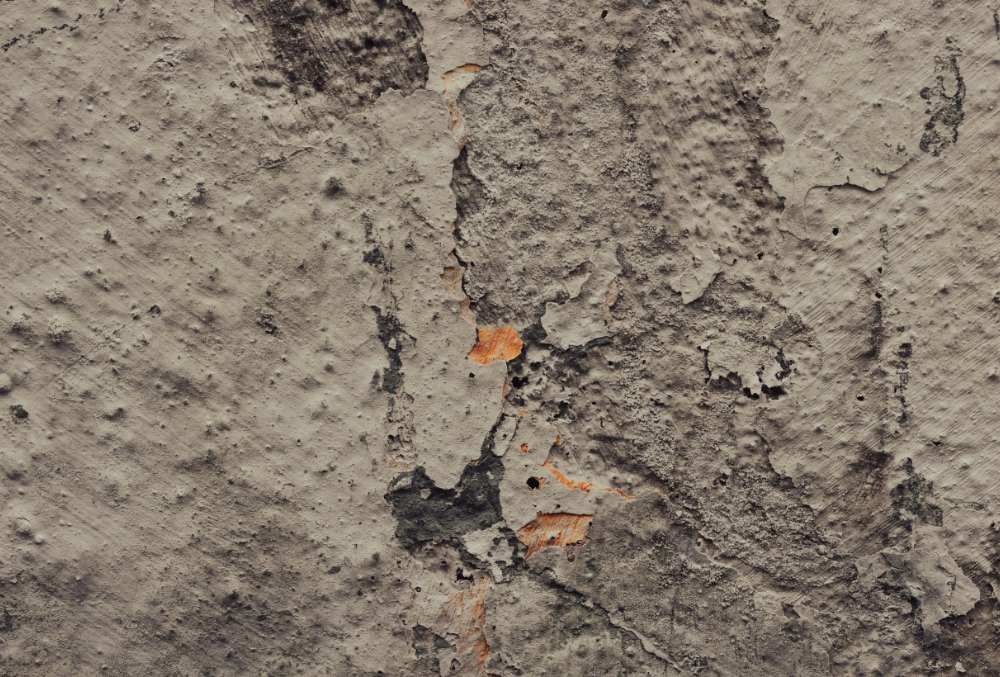
Business owners who inherit a commercial property, or who simply haven’t had their concrete assessed in a few years, often underestimate how much has changed. The visual indicators of humidity-driven damage include:
- Rough, sandpaper-like surface texture where smooth concrete used to be
- Visible cracking, even hairline, across flat sections
- White, chalky patches (efflorescence) near drainage areas or wall bases
- Green or black discoloration in shaded sections
- Flaking or lifting in areas near loading docks or water exposure points
- Color variation across the surface where sealer failure has been uneven
None of these are cosmetic issues — they’re evidence of structural processes that will continue and accelerate without intervention.
The Protection Solution for Louisiana Commercial Properties
The answer to humidity-driven concrete damage isn’t simply sealing — it’s the right sealing system, properly applied, for the specific exposure conditions of the property. A coating system appropriate for a climate-controlled interior is not the same as what’s needed on an exterior dock facing Gulf Coast weather year-round.
CCI Gulf Coast has worked with South Louisiana’s climate for over 30 years and understands which systems hold up and which don’t. Every commercial project begins with a surface assessment that identifies existing damage, moisture levels, and the specific threats the property faces — then specifies a coating system engineered for those conditions. The connection between humidity damage and business presentation is also direct. Concrete that has been degraded by moisture looks neglected — and that appearance has real consequences, as explored in our breakdown of worn concrete and business image. Addressing the underlying cause and the surface result together is how durable, professional outcomes are achieved.
Protect Your Commercial Investment Before the Next Storm Season
Don’t wait for visible structural failure. Call CCI Gulf Coast at (985) 542-2757 or request a free property assessment online to have your commercial surfaces evaluated before Louisiana’s next storm season compounds existing damage.